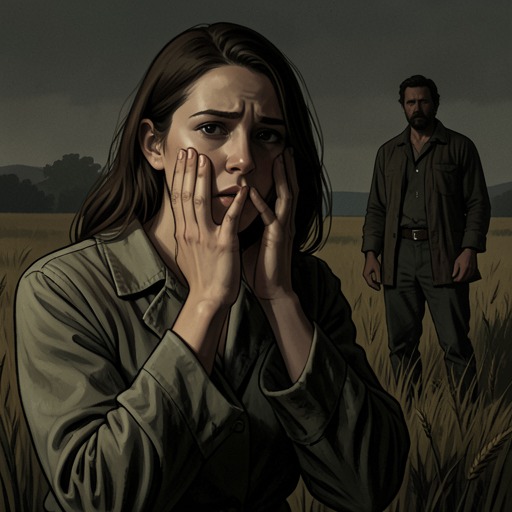
Mariette Larkin
The Darling Buds of MayMariette Larkin is Pop Larkin’s eldest daughter, an accomplished rider whose presence unsettles Cedric Charlton’s first impressions and becomes an increasingly important part of his life at the farm. The story introduces her through family routines and the seasonal work of strawberry picking, then develops her character through her perceptiveness, her father’s evident tenderness, and her conflict with Pauline Jackson. Her place in the narrative is both intimate and practical: she is a daughter at the centre of Pop’s affection, a young woman whom Cedric comes to care for, and a participant in the labour on which the household depends.
Identity and Introduction
Pop recites the names of his children while the family travels together, but notices that only five voices answer when he calls six names. Mariette then replies that she is present. This brief exchange establishes her as part of the crowded family world while also making her momentarily distinct: Pop is attentive to the absence of her voice, even amid the children’s noisy responses.
When the family reaches the yard, the younger children jump down from the truck into Pop’s waiting arms. Mariette remains above them, dressed in jodhpurs and a pale lemon shirt. She stands upright, with black hair, olive skin, soft eyes, and a slender, delicate build. Pop sees in her a resemblance to Ma at the same age, and holds his arms up tenderly when Mariette says she can climb down by herself. The scene gives her both independence and a place within the affectionate family intimacy Pop creates.
Pop describes his eldest daughter to Cedric as crazy about horses and mad on riding, then offers to introduce them. Cedric, who has come to the farm in connection with a tax form, is distracted by the sight of Mariette crossing the yard. Their introduction is therefore marked by an imbalance: Pop makes a straightforward social offer, while Cedric’s attention has already been captured by her.
Riding and Cedric’s Changing View
Mariette’s riding helps define her before Cedric understands who she is. She later asks whether he had believed that she was the same girl he had seen riding at Easter. Cedric admits that he had not; Mariette says she guessed from his eyes because she had been watching him. Her observation turns the mistaken impression back on him: he has been looking at her, but she has also been studying his response.
The exchange suggests a perceptive, self-possessed character. Mariette recognizes Cedric’s uncertainty without needing him to explain it, and names what she has seen. The riding episode matters not simply as evidence of her skill, but as the point from which Cedric’s understanding of her is revised. His first impression had divided the rider he remembered from the young woman before him; Mariette notices the discrepancy and brings it into the open.
Family, Work, and the Seasonal Round
The family’s life is organized around the agricultural calendar, and Mariette belongs to that world. In spring the truck passes strawberry fields laid with fresh yellow straw. Pop explains that the picking will begin soon, and the family discusses the work as a regular source of income. Strawberries are followed by cherries, then, in suitable summers, apples, plums, and pears; later come apples again, hops, and potatoes. At strawberries alone, Pop says, a large family can earn fifteen pounds a day.
The season begins unusually early. Montgomery reports that picking at Benacre will start on Monday, and Pop attributes the early crop to the weather. The contrast between the bright orchard landscape and the family’s practical attention to harvest makes the land both setting and livelihood. Mariette’s place in the story is consequently not confined to courtship: she belongs to a household whose routines and prospects are shaped by the timing and condition of its crops.
That dependence carries a warning as well as an opportunity. Pop says the strawberry trade is nearly over because of disease, naming several strawberry varieties as finished and predicting that within two years strawberries will be gone everywhere. The family’s seasonal pattern is therefore vulnerable to ecological change. The harvest offers immediate work and substantial earnings, but its future is uncertain, placing Mariette’s family life within a wider economic transition.
Strawberry Picking and Conflict
Cedric’s experience in the fields gives him a close view of the labour Mariette shares. On an exceptionally hot day, he struggles with the conditions of work and later calculates that he has checked in more than a ton of strawberries. His estimate makes the scale of the picking concrete: what he had encountered as a tiring day’s labour is also a substantial flow of produce and potential earnings for the pickers. He wonders about the tax position and assumes Pop will know, bringing his official expertise into contact with the practical economy of the farm.
The fields are also the setting for Mariette’s confrontation with Pauline Jackson. Cedric sees the two women in the middle of a fight and initially mistakes the red on their faces and clothes for blood. He realizes that they have been rubbing crushed strawberries on each other. The incident makes the crop part of the conflict’s circumstances and imagery: strawberries are at once the season’s livelihood and the material through which the struggle is carried out. Cedric’s attention is divided between alarm at the confrontation and his growing concern for Mariette.
The clash broadens the farm’s work setting into a social world of its own, observed by fellow pickers and family members. Cedric sees Ma among the onlookers, but cannot determine her response. That uncertainty keeps the scene from resolving into a simple account of who supports whom; instead, it emphasizes how the conflict unfolds in public, amid the collective life of the picking field.
Relationships and Narrative Significance
Mariette’s relationship with Pop is conveyed through small acts of attention rather than explanation. He notices when her voice is missing, remembers how Ma looked at her age, and offers his arms when she insists she can get down alone. His pride in her riding becomes the first information he gives Cedric about her. Together, these details show a father who is alert to her presence and delighted by her abilities, while allowing her to assert her own competence.
Her connection with Cedric develops through his changing perception. At first he is absorbed by her appearance in the yard; later, their conversation about the rider at Easter reveals that Mariette has been watching him as closely as he has watched her. His attention deepens during the strawberry-picking episodes, where the work exposes him to the conditions of the family’s livelihood and to Mariette’s conflict with Pauline. Their relationship thus grows within, rather than apart from, the shared routines of the farm.
Mariette links several strands of the narrative: family affection, riding, romantic recognition, seasonal labour, and the fragility of a rural economy. She is introduced amid a noisy family journey and the bloom of the orchards, then encountered again in the strawberry fields where the harvest brings both earnings and conflict. Her presence gives those settings a human centre, while the family’s dependence on crops makes clear that her world is shaped by forces larger than individual feeling: weather, disease, and the uncertain continuation of the strawberry trade.